
A door we left open.
A Monday-night jam, a fiddle demo, and three live sessions.
The Monday jam
After Chris moved back to Nashville in 2023, he started a weekly jam at the house. The plan in his head was a modern-day version of Larry Perkins's legendary jams — selective list, slow growth into a place where musicians had somewhere to play. The first jam had big names. It also had old friends who were brilliant players but weren't on labels or in big-name bands.
That's when the jam became all-inclusive. The door was open Monday nights to anyone who wanted to come. Some weeks no one did. Some weeks it was just Svend. The door stayed open. The jam grew, and grew known for being inclusive, and the "no rules, no heroes" approach persists.
January 2025 — at Matt's
Matt had bought a fiddle from Stuart Duncan and was practicing hearing Tartini tones over double-stops while listening to the first three minutes of Beethoven's 7th, second movement. He'd record himself most days, just enjoying the shifting resonances. After a few weeks he realized he had melodies. He didn't write them — they popped out. He played, they came out to play too.
By the end of January he'd amassed forty-some tunes. He narrowed them to favorites, made demos, and sent them to Chris.
March 2025 — the call
Chris listened, and the next time he and Matt spoke they discussed making a record. Matt mentioned a third musician on utility — mandolin or banjo, whatever the song called for. Chris started telling Matt what he'd heard in the demos: droning between registers, lots of counterpoint in the melodies, cello, more instruments, more textures.
Matt got quiet, then explained the Stuart Duncan fiddle, the Tartini tones, the Beethoven. Chris hadn't known any of it — he'd isolated every variable from the audio alone. Matt had written all the DNA he'd been consuming right into the songs.
Matt asked Chris to co-produce. He accepted.
Three sessions
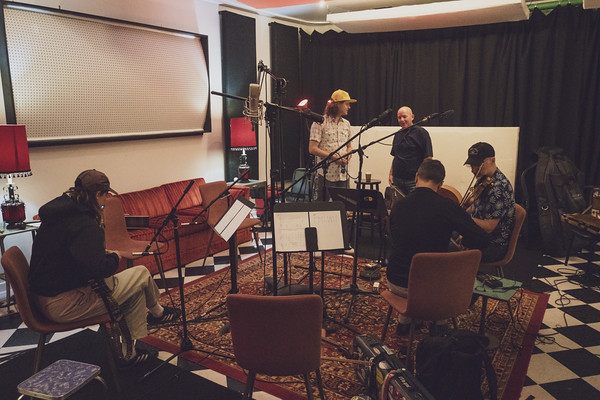
The recording took three sessions. Every song tracked live. Every microphone with full bleed. No headphones — everyone in a single room, full sight of each other. Mark Howard had designed Matt's room. The room is as much an instrument as the players.
Session one — Matt and Brittany Haas on fiddles, Natalie Haas on cello, Dom Leslie on mandolin and octave mandolin, Dennis Crouch on bass, Chris on guitar. After two days of being in a groove state with the greatest musicians in the world, Chris went home and the wave hit — joy, gratitude, the knowledge of being back where he belonged.
Session two — Matt with Brìghde Chaimbeul on Scottish smallpipes, passing through Nashville. Strings added afterward.
Session three — Matt, Dom, Dennis, Chris, plus Allison de Groot on banjo and a couple of tracks with Jason Carter and Bronwyn Keith-Hynes. Chris played three-finger banjo on one of those.
Two rooms
Matt's tracking room is where the live takes happened — designed by Mark Howard, with the comfort of a place you just want to be in. Period pieces, good lighting, Mark's acoustic decisions doing the unseen work.
Chris's place is where re-amping and mixing happen — a high-end studio hiding in a bedroom. The goal he'd set when he assembled the gear was one channel of outboard typical for an Alan Jackson session. After Matt's record was tracked, they knew they'd re-amp through it. The short version of the gear story: clean, solid, whole performances captured with good microphones, then brought out with very good equipment.
The name
After they finished tracking Matt's record and started a second client, Chris was leaving Matt's place one night and mentioned "The Collective." When he got home he texted Matt with the full name — the band, the label, the studio experience, and the group of musicians and artists who continue to build it. The Nashville Collective.
How they work
Chris and Matt work well together. Each notices things the other doesn't pay attention to. The rooms are complementary — each suits its owner's thinking style — and together they suit making records without guardrails.
It's not typical to see musicians in a single room with nothing between them. No headphones. No click. No way to recover. It's a more traditional approach. After years of editing the life out of songs, it's the only way they want to record when possible.
What makes it work is the lack of ego. No bosses. No people with bad ideas. Nobody making mistakes. The job is to enjoy the session.
The less you try, the better it sounds. That's the paradox, and the foundational ethos of The Nashville Collective.